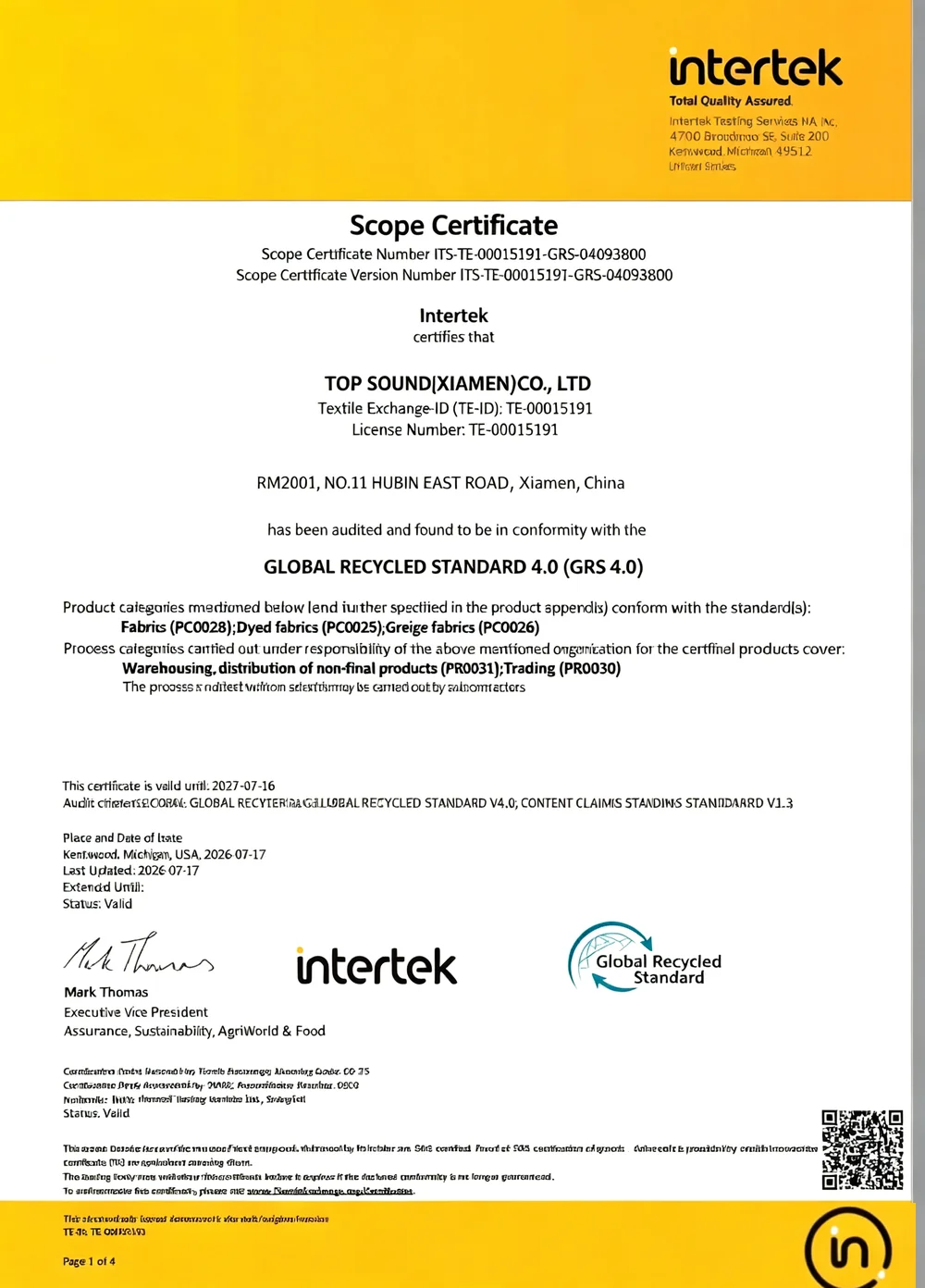
Why European & US Importers Now Treat GRS Certification as a Hard Gate for Cooler Bag Sourcing
By Weir Zheng, Founder of Top Sound — a Quanzhou bag manufacturer since 1989 (BSCI, ISO 9001, SEDEX, GRS certified).
Introduction
Over the past two years, we’ve watched a clear shift at the buyer’s table. Five years ago, a cooler bag inquiry might open with “price and lead time.” Today it often opens with: “Are you GRS certified?” For importers serving the EU and US mid-to-premium market, GRS (Global Recycled Standard) has moved from a nice-to-have to a hard gate. As a factory that runs GRS-certified production lines, here’s the plain-language view from the manufacturing side.
What GRS actually verifies (beyond “recycled”)
GRS is not a single material test. It is a full-chain standard administered by Textile Exchange. For a cooler bag, certification covers:
Recycled content threshold — a minimum percentage of recycled material in the fabric, with tracked mass balance.
Chain of custody — every step from recycled-fiber supplier to finished bag is documented and audited.
Restricted substances — chemical inputs must meet limits (aligned with REACH-type requirements).
Social & environmental management — the factory must hold recognized social audits (we pair GRS with BSCI/SEDEX) and control wastewater, energy and labor practice.
Labeling integrity — claims on the product and packaging must match the certified percentage.
In short: a GRS tag means the “recycled” claim can be traced, not just asserted.
Why EU & US buyers made it non-negotiable
Regulation is catching up to marketing. The EU’s green-claim rules are tightening; vague “eco” language now carries legal risk. A certified standard is defensible.
Retailers demand proof. Major EU/US retail and brand programs require supplier-level certifications before onboarding.
End consumers verify. B2B buyers know their own customers scan for credible eco labels. GRS is one they recognize.
Supply-chain risk. Without chain-of-custody documentation, a single non-compliant batch can trigger a recall or delisting. Certification de-risks the program.
What it means on our production floor
At Top Sound, GRS runs as a disciplined process, not a certificate on the wall:
Recycled fabric is received with valid TC (Transaction Certificate) and segregated from virgin stock.
Cutting, sewing and packing for GRS orders follow separated, documented work orders.
We issue traceable documentation per shipment so the importer’s own audit is clean.
Combined with BSCI / ISO 9001 / SEDEX, the social and quality baseline is already in place.
A practical note for buyers
GRS is achievable for mid-to-high-end programs, but it changes two things early: material spec (recycled-content percentage must be fixed up front) and cost (certified recycled fabric and audit overhead add a premium). For brands targeting the EU/US premium shelf, that premium is now the cost of entry — not a differentiator.
Bottom line
If your cooler bag program sells into Europe or the US premium channel, treat GRS as a qualification filter, not a marketing option. Ask suppliers for the valid certificate number and a recent TC, not just a logo in the catalog.
Weir Zheng has 35+ years in bag manufacturing and leads Top Sound’s OEM/ODM programs for global brands. Reach the factory at www.topsoundco.com.